Sunday, October 17, 2010

JDP2/FW1: I have a lot of beer


That's my fermentation room/basement beer closet. At present, it features five cases of beer: two cases of SR5, two cases of FW1 and one case of JDP2. It's fair to say that I'll be good for beer when all this homebrew is ready to drink come November.
On Friday, I bottled the FW1 cafe con leche stout and the JDP2 American scotch ale (which turned out to be more of a scottish ale due to the 6.4% A.B.V.). Now they'll need a few weeks in the bottle before they're ready. I'm hoping for a lot from the bottle conditioning.

I took this photo with my iPhone because my digital camera was on the fritz. Later, I went online to see if I could fix it. Most of the advice was to slap the lens. Sure enough, one good whack later and the camera was back in business.
The stout still had a sour taste, but I asked around about it and that might not mean anything. Evidently, many stouts, including Guinness, have a sour flavor (in fact, I picked up a four-pack of Guinness' new Foreign Extra Stout and sure enough there was a sour component). Still, I want the flavor tamed a bit. The additional dry malt I added for bottle fermentation and a few more weeks of aging may help.
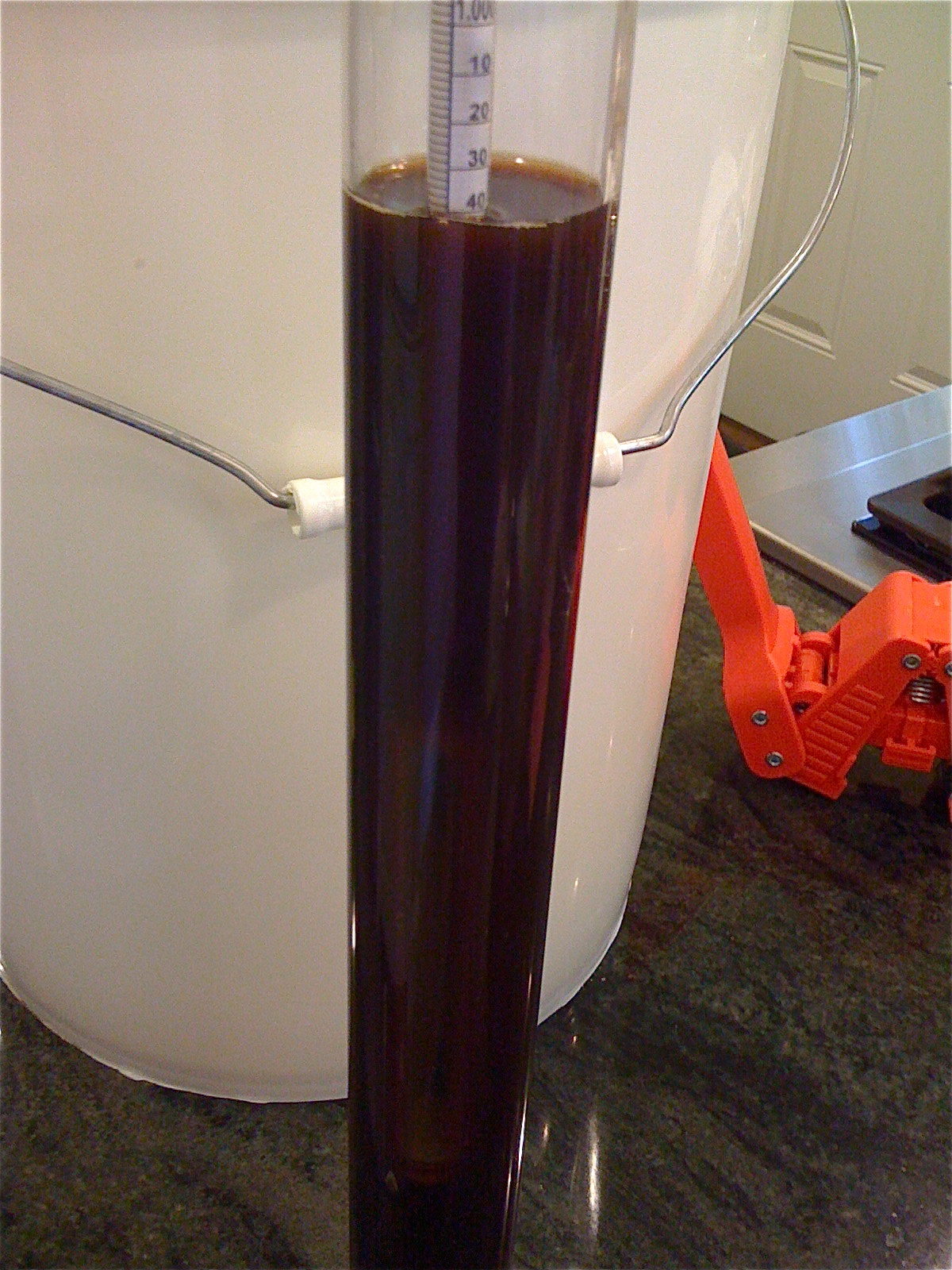
The other issue I had with the stout was poor attenuation. After nearly two weeks of fermentation, the stout went from an original gravity of 1.072 to a final gravity of 1.042. That's only 40% apparent attenuation. I was expecting around 70%. I don't mind that the A.B.V. is 4%, but I am disappointed in how poorly the yeast performed. I do wonder whether I should have let the stout ferment even longer, and what effect the lactose had, but all that is moot now that the beer is in the bottle.
On the bright side, I did get a distinct coffee/espresso flavor from the beer. So I'm hopeful that the beer will be drinkable next month.


In terms of flavor, JDP2 came out better. It's certainly not nearly as malty as JDP1, but I think I went to far the other direction. The beer was almost too dry, and I missed the brown sugar. In fact, you can see from the light color of the beer that it's not quite right. A scotch ale should be a dark amber. This is much more of a Scottish ale in color and alcohol content.
The reduced malt did allow the flavor of the rye to come through, so that's working well, but I'm didn't get much of the smoked malt. That may change after the beer finishes bottle conditioning. For the next batch, I think I add the brown sugar back in and maybe another pound or so of pale malt. I'm getting close, but I'm not quite there.

Wednesday, October 6, 2010

SR5/JDP2/FW1: Three beers and one long day


Saturday was a long day. It was a good day. A lot of beer was made and bottled on Saturday, but it was a long day.
Initially, I planned to bottle SR5 on Saturday. Just a quiet few hours sipping beer and bottling my wet hop IPA. No muss, no fuss.


Then I found out my buddy Andy got a homebrew kit, so I decided to go ahead with the next version of the JD Project and show him how to brew a batch of beer. I needed to do this anyway if I'm going to have the recipe worked out by the time the bourbon barrel is ready. Not a big deal though. Because I'm still tinkering with the American Scotch Ale recipe, I only make 2.5 gallon half batches.
A small batch of beer and then some bottling; eh, it'll be busy, but easy.


Then I got an email from my buddy Mike Roy. Turns out he's having trouble firing his kettle at the brewpub and is giving away wort before he has to dump it out. Well shit, I'm not going to turn down free wort. It's the most expensive part of the brewing process. Besides, it's for a stout, a style I enjoy, but haven't made yet. So last Thursday, Savannah and I headed over to Franklin's with my carboy. The catch was I needed to get it reboiled and fermenting as soon as possible. That meant adding it to Saturday's to-do list.
So what was to be an easy bottling day turned into a double brew day and bottling. Good thing I had an extra pair of hands. Andy was also good enough to shoot all the photos for this post. His camera is exponentially better then mine.


Let's start with JDP2. I cut 2.5 pounds of extract from the recipe, as well as the brown sugar. I kept the secret ingredient (rye), the crystal malt and added smoked malt. The subtraction of the extract made a huge difference in the O.G. JDP1 started out with a monster O.G. of 1.130, while JDP2 came in at a more manageable 1.066. Frankly, I think that might be a bit too low, so the brown sugar might return in the next batch. I'm also very curious about the smoked malt. I was concerned that it would dominate the flavor, but when I tasted the wort, I could barely detect it. As the beer ferments and the sugars are processed, the smoke flavor might come through a bit better. Otherwise, I'll increase the amount next time.
Speaking of JDP1, I entered it into a homebrew contest a few weeks ago. The contest was part of the inaugural D.C. State Fair. The whole thing felt a bit thrown together (I had to leave the competition to run and get the judges some cups to use), and I knew JDP1 was far from being perfect. Still, it was an opportunity to have a few unbiased opinions. The good news was, the judges picked up that it was a scotch ale. The bad news, they thought it was too boozy and sweet, both of which I knew. Next year, I'll be better prepared for the contest. Hopefully, the organizers will be, too.


In addition to JDP2, Andy and I worked on the wort Mike gave me (FW1: Free Wort 1). Because it was free, I screwed around a little with it. Rather than finish making a stout, which I would have done if I were starting from scratch, I decided to do an espresso milk stout, a cafe con leche stout, if you will. I also decided to punch up the alcohol percentage a bit. The wort was at 1.050 when Mike gave it to me. By the time I was done, the O.G. was up to 1.072. This was a result of adding an extra half pound of pale dry extract and reducing about a gallon of the wort by half to concentrate the flavors. I also added a quart of espresso and half a pound of lactose. All of this was on top of Mike's original grain bill of maris otter, crystal 120, roasted barley, chocolate malt, black patent and carafa III.
Generally, I feel pretty good about all of this. However, the wort had a slightly sour flavor when I was done with it. Now, I don't know if this was a result of the espresso or the lactose, neither of which I've worked with before, or reducing the wort as much as I did. As long as it's not an infection and gone by the time I bottle, I'll be happy. Still, I'm worried that the two days the wort had to sit before I could boil it again might have damaged it. We'll see.
Finally, there was the bottling of SR5, the dry hopped, wet hop, single hop IPA. That beer smelled fantastic. The color was a beautiful light orange and should be great by the time I crack into it on Halloween. I am starting to rethink the use of whole hops for dry hopping. It's a pain in the ass to scoop out the hops before bottling and I'm always concerned that I'm adding extra particulate to the beer. For my next IPA, SR6, I think I'll try using pellets and a hop bag.


Now it's back to waiting. I'll bottle JDP2 and FW1 next weekend and open them up in early November, a week or so after SR5. Hopefully, juggling so many projects in a single day didn't result in me screwing up all three of them.

Sunday, September 12, 2010

SR5: Single Hop, Wet Hop


Well, several months after planting hop rhizomes in my backyard, I've just finished my first batch of wet hop IPA using a full pound of fresh Centennial hops.
Now if only I can get my own hop plants to produce some cones I'll be in business.
I bought the fresh hops online from Rebel Brewer. They had a nice selection and decent prices. However, they left my can of Super Moss out of my order, but they promised to fix the problem on Monday. Despite that, it was nice to come home to find all of my brewing ingredients waiting for me on the porch.


Ideally, I would've waited until this morning to brew, but with fresh hops, time is everything. They deteriorate quickly, so you have to use them as soon as possible. So despite having moved my buddy Tim in the morning and then spending four hours in a bar watching South Florida give a game away to Florida, I had to come home and brew beer. Not the worst thing, it just made for a long day.


Practically speaking, brewing with fresh hops isn't any different than brewing with pellets or dried hops. The only thing is, you can't dry hop beer using fresh hops. Because the fresh hops are straight from the field they're covered in bacteria. A few minutes in boiling wort and your bacteria problems go away, but that means fresh hops should only be used for flavor (If you grow your own hops and have a whack of them, you could use them for bittering, too. But if you're paying $15 a pound, make the most of the fresh hops and use them for flavor.).
To accentuate the Centennial hops, which have many of the same citrus flavors Cascade hops have, I used them throughout the beer. I used two ounces of Centennial pellets for bittering, a pound of fresh hops for flavor and I have five ounces of dried Centennial hops that I'll dry hop with next week.
For malt, I used eight pounds of pale and one pound of light crystal. Again, this is to help accentuate the flavor of the hops. That said, the sweet crystal malt gave the wort a nice caramel flavor and a beautiful orange color.


Once I got the wort down to 69 degrees, I pitched my London Ale III Yeast from Wyeast. It's a good yeast for hoppy beers and it has high flocculation, which should help clarify the beer (important since the Super Moss didn't show up). My original gravity came out at 1.070.
Looking at the calendar, this batch of beer should be ready to drink by Oct. 31. Happy Halloween, indeed.
As for my own hop plants, the Cascade continues to thrive, but the Willamette and Centennial vines are coming on, and none of the hops have produced cones yet. Clearly, this year is a wash, but that's typical for first-year hop plants.
And on a completely unrelated note, check out my shrimp and grits, and foie gras recipes on CraftBeer.com.

Monday, August 23, 2010

JDP1: Jeremy Clarkson and the Five Gallon Carboy


The first Scotch ale test batch is in the books. Happily, it's not only drinkable (if boozy), but it tastes and looks like a Scotch ale (more or less). But given the fact that I way over shot my target alcohol range of 7.5-8.5 percent and landed at 13 percent, there is no future for this batch.
That doesn't mean it's going to waste. As with every batch of beer, I learn a little more. With this batch, I know that 7.5 pounds of malt and a half pound of honey and brown sugar is too much for a 2.5 gallon batch. Good to know. I also know now that I need to be more careful in selecting my yeast. Seeing as the beer will settle in the 7 to 10 percent A.B.V. range, I need a yeast that can deal with that much alcohol and that many sugars. And when I do my next wort, I now know not to cover the pot.
(By the way, shouldn't Charlie Papazian have pointed that out in The Complete Joy of Homebrewing? It's pretty fucking important and it took listening to hours of Brew Strong shows before I heard a passing reference to boiling the wort uncovered. It consentrates the wort, which is great, but it prevents you from infecting the beer with the condensation that can collect on the pot lid and drip back in the wort. I think not infecting the beer is a good thing to address in a homebrewing guide. After learning this tidbit of info, I had to spend a couple hours researching how to compensate for the lose of liquid during the uncovered boil. John Palmer covers the whole subject on his Website, How to Brew.)


Now that JDP1 is complete and decent, I've given it a name: Jeremy Clarkson. Clarkson is the host of the British car show, Top Gear, and whose philosophy can be boiled down to "more." More horsepower, more torque, more speed, more, more. So I thought it would be fitting to name my high-alcohol malt bomb after him. I've also entered Jeremy Clarkson in the inaugural D.C. State Fair's Homebrew contest. I don't expect to win, but I am looking for feedback. Like I said, I think it tastes like a Scotch ale (more or less), but I want some unbiased feedback.
Speaking of names, I've renamed this blog. Gastronomy is now Five Gallon Carboy. It's to reflect the transition of the blog from cooking to homebrewing. (A carboy is the glass vessel that looks like a water-cooler jug that homebrewers ferment their beer in.)
Finally a hop update. The Cascade hops (right) continue to thrive, nearly reaching the end of the nine-foot line. However, the Willamette hops (center) have come on strong in the last couple weeks, overtaking the Centennial hops (left). Now, the latter two hops have a long way to go before they catch up with the Cascade hops, but it's good to see they're still growing.


This being the first year of growth, I won't get any yield to speak of, but I will be wet hopping a beer in a couple weeks. Some folks from D.C. Homebrewers sent out word that Rebel Brewer was taking orders for fresh hops. To get a feel for making a wet hop beer (meaning that I use fresh hops instead of dry hops or pellets) I ordered a pound of Centennial to make a Centennial IPA. In addition to the fresh hops, which will be used for flavor, I picked up some Centennial pellets for bittering and dried Centennial hops for dry hopping.
It should be interesting. Hopefully, it will be good.

Sunday, July 18, 2010

JDP1: Yeah, it's a big beer

Just bottled the case of JDP1 and as expected, it's a very big beer. The final gravity came out at 1.035, which means I got about 10 points of attenuation resulting in a 13% A.B.V. beer -- nearly three times the alcohol content of the average beer.
Despite all that alcohol (which you could smell and taste), it didn't taste that bad. Even in its raw state, the flavor was much better than I expected. I dumped a whole bunch of malt, honey and brown sugar in the wort, which resulted in the 13% alcohol content, but the beer wasn't particularly sweet and certainly not cloying. The malt flavor was there, but so was a strong bitter note and a bite, which where were due to the hops and the secret ingredient.
The flavor and final gravity also benefitted from the Scottish Ale yeast I used. Clearly, it was a good call to use twice the amount of yeast I needed for a 2.5 gallon batch, because the yeast thinned out the body of the beer fairly well, giving it a bit of a dry characteristic (well, as dry a characteristic as a 13% malt bomb can have). The color was also good, a real nice dark, dark amber.

Getting ready to bottle the beer, I was struck by the amount of trub that settled in the bottom of the carboy. I haven't produced that much gunk in the 5 gallon batches I've made, including the 7% IPA I recently finished. It just shows you how much malt and yeast went into the 2.5 gallon batch of beer.
So now it goes into the closet to bottle ferment for the next seven weeks (or so). I'll probably pop open a bottle toward the end of August to see how it tastes. Based on some recommendations I've gotten from other homebrewers, I may let a few of the bottles age for up to a year or more just to see what happens. If the beer is as good as I think it may be in a month, it will be absolutely fantastic in a year.
Regardless of how good it was, though, the alcohol level was way too high. I'll name this batch when it's ready and try again in a couple weeks. I need to get the recipe worked out by the end of the year, so I was happy to land somewhere in the ballpark of a Scotch ale. It's not perfect, but it ain't bad.

Sunday, July 11, 2010

SR4: At least it's hoppier

So I need to dial back on the amber malt.
One of the main things I wanted to do with SR4 was lighten the color. As you can see, though, it looks exactly like SR3 (SR3 is on the left, SR4 is on the right). In fact, when I asked my wife to pick between them based on color, she thought SR3 was the lighter one.
Well, shit.
I reduced the toast on the crystal malt to try and lighten the color some for SR4, but obviously that wasn't enough. For the next batch, SR5, I'll swap a couple pounds of amber malt for a couple pounds of plain, or light, malt. I'll also go back to the darker toast on the crystal malt. Now that I know it doesn't really effect the color of the beer (at least not much), I'll go with the darker toast because I prefer the flavor.
The dry hopping worked better this time and I like the flavor of the beer a bit better. For this batch, I dry hopped three ounces of whole Cascade hops for two weeks. The result is obvious. Close your eyes and stick your nose in the glass and you can smell the difference between SR3 and SR4. However, it could be better.
Listening to an old Brew Strong show the other day, I learned that I've been dry hopping too early. Rather than adding the hops at the start of primary fermentation, I should be adding them toward the end of primary fermentation. Apparently, I can also be even more aggressive with my hopping. Three ounces for a five gallon batch is about the minimum I should be using. So for SR5, I'll be dry hopping with at least five ounces of whole hops after about 10 days.
So SR4 isn't a bad batch, it's just not as polished as I wanted it to be. Hopefully with SR5, I'll be able to work out the color and dry hop kinks, slap a name on the beer and move on to the next recipe.

Sunday, July 4, 2010

JDP1: It's a malt monster

1.130.
I looked again. After all, it was 5:20 in the morning. There it was, though, 1.130 at 64 degrees. I'd made a malt monster.
To clarify, my original gravity of SR3 was 1.070, which eventually resulted in 6.7 percent alcohol by volume. So an O.G. of 1.130 puts me in double digit A.B.V. territory, when I was shooting for around 8 percent, or an O.G. of 1.075 to 1.085.

This is my first crack at making a Scotch ale, so I knew I wouldn't get everything exactly right. However, I didn't expect to produce a barleywine. The problem is, I added way too much malt, and the more malt you have the higher the gravity. So for JDP 2, I'll probably cut about two pounds of malt and see where the I end up. Hopefully at a more reasonable gravity.
As for this batch, because I'm still in the testing phase, I only made two and a half gallons, but used a full package of yeast. Given how much malt and sugars are in that carboy, those yeast have plenty to eat. And with some luck, all that yeast will help the beer attenuate down to something a bit drier and drinkable. We'll see.
Man, can you imagine the alcohol bomb this beer would be if I aged a 10 or 11 percent beer in my bourbon barrel? The guys at Brewdog might recruit me.
So that's might first obvious problem. There were some bright spots, though. The wort tasted pretty good. Understandably malty, of course, but not cloyingly sweet, and the bitterness of the hops and bite of the secret ingredient came though (a small miracle, really).

Also, the color is spot on. The dark caramel amber is exactly what I wanted. It's a result of the very dark toast on the crystal malt and probably the honey. Yeah, and the use of honey and light brown sugar seemed to go well. I expected those flavors to be too sweet in the wort, but they didn't dominate the flavor at all. And because they're fully fermentable sugars, the yeast will make short and compete work of them.

As for the yeast, I used a Scottish Ale yeast from Wyeast that came in this crazy pouch. There was a small yeast packet suspended in a solution within the pouch that I had to pop the day before. A few hours before pitching, I pulled the yeast out of the fridge, shook it and the pouch swelled until it looked like a brand new Capri Sun. Pretty cool. Bob at the homebrew store said the yeast were hearty and would attenuate well in the beer (yes, attenuation is the word of the day). I hope he's right. There's a lot of sugars to process.

Bob and the homebrew store are in Frederick. I had to run by the Flying Dog brewery on Friday to pick up some T-shirts, so I decided to hit the Flying Barrel and save myself a trip to Columbia or Falls Church (lot of flying shit in Frederick, no?). It's a nice little shop a couple blocks off Market Street, the main drag through the historic district. And when I say little shop, I mean little shop. I was standing across the street and it still took me a minute to spot the place. That said, it's probably a little bigger than myLocal-Home-Brew-Shop in Falls Church, but it just disappears in the warehouse building it's located in. Nevertheless, Bob had everything I needed, so no complaints.