Sunday, December 5, 2010
JDP3: So far, so good
I think this might just be the batch.
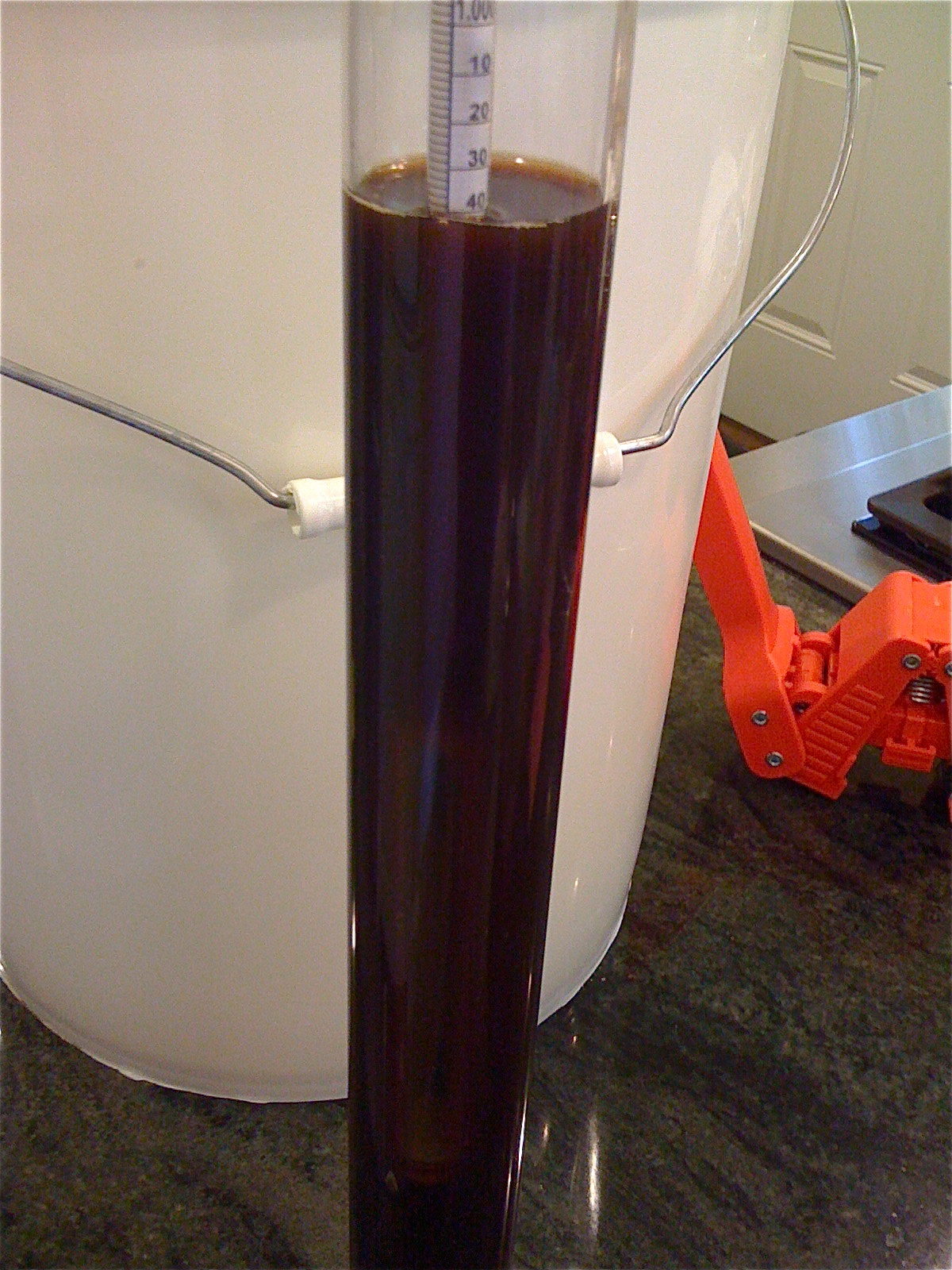
I bottled JDP3 this afternoon and judging by the final gravity (1.020), A.B.V. (10%), and taste, this might just be the recipe that I'll remake and stick in the bourbon barrel. The color is good, if a little lighter than I expected, and the wort tasted malty with the bite of rye clearly coming through. And there's just enough flavor from the smoked malt to let you know it's there. Once this gets a few days in the barrel, I think it'll be phenomenal.
However, now I'm working against the clock. I'll get a chance to taste the nearly finished beer on Dec. 21, the day before I fly to Florida for Christmas and New Years. I get back on Jan. 6. Realistically, I can get the next batch going on Jan. 7, and get it in the barrel by Jan. 12. The beer will then be in the barrel up to a week, which means it'll have about two weeks to bottle condition it before I ship a couple samples off to The Bruery. That's a tight time frame. Hopefully, Jan. 31 is the deadline to submit the beer, but the judges won't sample them for another week or so.
Even if I don't win -- and odds are that I won't -- I'll be happy to wrap up this project. I was hoping to have the American scotch ale recipe worked out by the time the barrel was ready and it looks like I meet that deadline. Because these batches are small, I'll probably do a second one before I stick something else in the barrel (stout?).
And a final hop update for the year: no hops. From the beginning, this year was a write off. I've heard and read that you should never expect much yield the first year you plant the hops. Well, sure enough, I didn't get a single damn hop cone this year. Not one. So, I'll take down the vines and look forward to a more robust season next spring (of course, one hop cone would constitute a more robust season). Fittingly, as my first year of hop farming comes to a close, I'm just about to finish off Digression³, my first wet hop IPA. The hop growth may have sucked, but at least the wet hop beer didn't.
Sunday, November 28, 2010
JDP3: The Goldilocks batch?
| Grinding rye by hand is as much fun as you think it is. |
The original gravity came in at 1.094, which is quite high, but no where near as high as the 1.135 the first batch started with. If the attenuation is good, I should end up with an A.B.V. of around 8 or 9 percent, perfect for a scotch ale.
For this batch, I returned the brown sugar and increased the amount of smoked malt. In the last batch, the smoked malt flavor never came through and the lack of brown sugar likely contributed to the lower A.B.V. (That said, JDP2 was a good beer, it just wasn't a scotch ale. Once I got past that, I realized it was a really good rye ale. With the lower amount of malt and no brown sugar, the rye was the predominant flavor. That wasn't what I was going for, so it took me a while to appreciate the beer I did have. Now that I'm down to a few bottles, I'm actually a little bummed. I really like it.)
I also picked up a couple hop bags for this batch. Talk about making a difference. Transferring the wort from the pot to the fermentation bucket took no time at all because I didn't have to keep cleaning hop goop off the filter. Those little nylon hop bags should mean I'll have little to no trub in the beer. Man, that'll be a nice change.
Should this batch work out the way I hope, I plan to submit it to The Bruery's Batch 300 homebrew contest. The winner gets to make a commercial batch of their beer on The Bruery's system and enter the Great American Beer Festival's Pro-Am competition. Now, I'm sure I have no chance to win, but what the hell, it never hurts to try.
Even if I don't win, even if the beer sucks, I have 10 liters of very good whiskey. Tell you what, though, that beer won't suck. Not once it's had time in my barrel of aged Early Times. I sampled some a couple weeks ago along side some regular Early Times. The difference was dramatic. The whiskey from the barrel was a rich caramel brown and was full of vanilla and brown sugar flavors. I like Early Times, but the stuff straight from the bottle paled in comparison to the 10 liters I'd aged for five months. It was nearly two different spirits entirely. If I can get the flavor of that whiskey to come through in the American scotch ale, I might just have a decent beer.
Saturday, November 6, 2010
FW1/JDP2: Cafe Con Leche and the Scottish Scotch Ale
| It took 10 minutes to pour this beer. |
The biggest problem with the beer is it's over-carbonated. I did add a bit more dry malt for bottle conditioning than I normally do, but I did so because think many of my beers have been a bit under-carbonated. Well with the stout, it takes five minutes to pour and I've already lost one to gushing and another to detonation (the bottle cap didn't pop off, the upper half of the bottle did). That said, once it's in the glass and settles, it's tart and a bit bitter from the espresso, and the creaminess of the body comes through ... once the carbonation subsides.
Since it's a espresso milk stout, I've named it Cafe Con Leche. Because I got the wort from Mike Roy at Franklin's, this batch is a one and done, but it has motivated me to tackle another stout in the next few months. I'll probably wait until I wrap up my scotch ale experiments.
| JDP2 on the left and JDP1 on the right. |
That said, JDP2 benefited as much from the addition of bourbon as JDP1. As you can see in the picture, JDP1 (on the right) is much darker than JDP2. It's also flat, while JDP2 has a nice amount of carbonation. JDP1 is overly sweet and overly boozy, while JDP2 is a bit thin and the rye gives it too much of a bite. Yet ... YET ... the bourbon cuts through both giving the beers a nice balance without overwhelming either. Isn't bourbon great?
| I rise the tasting glasses in a small amount of bourbon to simulate what the beer will taste like after aging in the bourbon barrel. |
Sunday, October 24, 2010
SR5: Delicious Digression³
"It tastes so fresh."
That was the best thing my wife could have possibly said to me. It tastes fresh.
It does, by the way. It really does. It's a wet hop ale. It's a single hop, wet hop ale. It's a dry hopped, single hopped, wet hop ale. It's Centennial hops from beginning to end and it is good.
I wanted to give SR5 another week to bottle condition, but I think it's ready. Tuesday is the next DC Homebrewers meeting, so I cracked open a couple to see if the beer is ready to drink. Man, is it. I really couldn't be happier with how it came out. It has a good bitterness that's well balanced by the crystal malt (20). The grassy flavor of the fresh Centennial hops comes right through, and the five ounces of dried Centennial hops make the beer stinky good.
I was worried that the wet hop flavor would be muted because of the number of days it took to get the hops from the field to me. But I hand it to Rebel Brewer, they were still fresh (it would've been nice if they remembered my SuperMoss so the beer would be more clear). It didn't help that Derek from myLHBS crapped on the idea of mail order fresh hops after I'd placed my order, but I guess he can suck it.
Nevertheless, this should be the last time I order wet hops from Rebel Brewer. With any luck, my own hops will be producing next year. If so, I can either look forward to a wet hop IPA with a combination of the Centennial, Willamette and Cascade hops I planted, or enough hops from each vine to do three single hops batches. Whatever the case, if the beers turn out as well as Digression³ did, then I'll be happy.
Digression³, by the way, is the name of the beer. Dry hopping a wet hop beer seemed like a digression from the concept (dry, wet, get it?). It's also a digression from the line of IPAs I've been working on. And I tend to digress a lot in my writing and conversations. The cubed refers to the three ways Centennial hops were used: bittering, flavor and aroma.
On a minor note, I got the carbonation right. The last couple batches, JDP1 and SR4, the beers were either under carbonated or not carbonated at all. I'd come up with all sorts of reasons why -- too much alcohol, not enough yeast, etc. -- but I started getting worried that I was screwing up something more fundamental, which would be harder to fix. So when I heard the wonderful tsst sound when I popped the cap on Digression³, I was pretty damn happy.
I also like the color. As you can see from the photo, it finished with a soft orange, brown color. That's more or less what I've been going for with the other SR beers. The difference between this beer and the other beers, in terms of malt, is the use of pale malt verses amber malt. Digression³ has no amber malt, while the other SR beers are almost all amber. I like the flavor of the amber malt, so I'll stick with it, but I'll swap out some for pale malt when I get around to making SR6.
For now, I have plenty of beer to drink.
Sunday, October 17, 2010
JDP2/FW1: I have a lot of beer
That's my fermentation room/basement beer closet. At present, it features five cases of beer: two cases of SR5, two cases of FW1 and one case of JDP2. It's fair to say that I'll be good for beer when all this homebrew is ready to drink come November.
On Friday, I bottled the FW1 cafe con leche stout and the JDP2 American scotch ale (which turned out to be more of a scottish ale due to the 6.4% A.B.V.). Now they'll need a few weeks in the bottle before they're ready. I'm hoping for a lot from the bottle conditioning.
Foreign Extra Stout and sure enough there was a sour component). Still, I want the flavor tamed a bit. The additional dry malt I added for bottle fermentation and a few more weeks of aging may help.
The other issue I had with the stout was poor attenuation. After nearly two weeks of fermentation, the stout went from an original gravity of 1.072 to a final gravity of 1.042. That's only 40% apparent attenuation. I was expecting around 70%. I don't mind that the A.B.V. is 4%, but I am disappointed in how poorly the yeast performed. I do wonder whether I should have let the stout ferment even longer, and what effect the lactose had, but all that is moot now that the beer is in the bottle.
On the bright side, I did get a distinct coffee/espresso flavor from the beer. So I'm hopeful that the beer will be drinkable next month.
In terms of flavor, JDP2 came out better. It's certainly not nearly as malty as JDP1, but I think I went to far the other direction. The beer was almost too dry, and I missed the brown sugar. In fact, you can see from the light color of the beer that it's not quite right. A scotch ale should be a dark amber. This is much more of a Scottish ale in color and alcohol content.
The reduced malt did allow the flavor of the rye to come through, so that's working well, but I'm didn't get much of the smoked malt. That may change after the beer finishes bottle conditioning. For the next batch, I think I add the brown sugar back in and maybe another pound or so of pale malt. I'm getting close, but I'm not quite there.
Wednesday, October 6, 2010
SR5/JDP2/FW1: Three beers and one long day
Saturday was a long day. It was a good day. A lot of beer was made and bottled on Saturday, but it was a long day.
Initially, I planned to bottle SR5 on Saturday. Just a quiet few hours sipping beer and bottling my wet hop IPA. No muss, no fuss.
Then I found out my buddy Andy got a homebrew kit, so I decided to go ahead with the next version of the JD Project and show him how to brew a batch of beer. I needed to do this anyway if I'm going to have the recipe worked out by the time the bourbon barrel is ready. Not a big deal though. Because I'm still tinkering with the American Scotch Ale recipe, I only make 2.5 gallon half batches.
A small batch of beer and then some bottling; eh, it'll be busy, but easy.
Then I got an email from my buddy Mike Roy. Turns out he's having trouble firing his kettle at the brewpub and is giving away wort before he has to dump it out. Well shit, I'm not going to turn down free wort. It's the most expensive part of the brewing process. Besides, it's for a stout, a style I enjoy, but haven't made yet. So last Thursday, Savannah and I headed over to Franklin's with my carboy. The catch was I needed to get it reboiled and fermenting as soon as possible. That meant adding it to Saturday's to-do list.
So what was to be an easy bottling day turned into a double brew day and bottling. Good thing I had an extra pair of hands. Andy was also good enough to shoot all the photos for this post. His camera is exponentially better then mine.
Let's start with JDP2. I cut 2.5 pounds of extract from the recipe, as well as the brown sugar. I kept the secret ingredient (rye), the crystal malt and added smoked malt. The subtraction of the extract made a huge difference in the O.G. JDP1 started out with a monster O.G. of 1.130, while JDP2 came in at a more manageable 1.066. Frankly, I think that might be a bit too low, so the brown sugar might return in the next batch. I'm also very curious about the smoked malt. I was concerned that it would dominate the flavor, but when I tasted the wort, I could barely detect it. As the beer ferments and the sugars are processed, the smoke flavor might come through a bit better. Otherwise, I'll increase the amount next time.
Speaking of JDP1, I entered it into a homebrew contest a few weeks ago. The contest was part of the inaugural D.C. State Fair. The whole thing felt a bit thrown together (I had to leave the competition to run and get the judges some cups to use), and I knew JDP1 was far from being perfect. Still, it was an opportunity to have a few unbiased opinions. The good news was, the judges picked up that it was a scotch ale. The bad news, they thought it was too boozy and sweet, both of which I knew. Next year, I'll be better prepared for the contest. Hopefully, the organizers will be, too.
In addition to JDP2, Andy and I worked on the wort Mike gave me (FW1: Free Wort 1). Because it was free, I screwed around a little with it. Rather than finish making a stout, which I would have done if I were starting from scratch, I decided to do an espresso milk stout, a cafe con leche stout, if you will. I also decided to punch up the alcohol percentage a bit. The wort was at 1.050 when Mike gave it to me. By the time I was done, the O.G. was up to 1.072. This was a result of adding an extra half pound of pale dry extract and reducing about a gallon of the wort by half to concentrate the flavors. I also added a quart of espresso and half a pound of lactose. All of this was on top of Mike's original grain bill of maris otter, crystal 120, roasted barley, chocolate malt, black patent and carafa III.
Generally, I feel pretty good about all of this. However, the wort had a slightly sour flavor when I was done with it. Now, I don't know if this was a result of the espresso or the lactose, neither of which I've worked with before, or reducing the wort as much as I did. As long as it's not an infection and gone by the time I bottle, I'll be happy. Still, I'm worried that the two days the wort had to sit before I could boil it again might have damaged it. We'll see.
Finally, there was the bottling of SR5, the dry hopped, wet hop, single hop IPA. That beer smelled fantastic. The color was a beautiful light orange and should be great by the time I crack into it on Halloween. I am starting to rethink the use of whole hops for dry hopping. It's a pain in the ass to scoop out the hops before bottling and I'm always concerned that I'm adding extra particulate to the beer. For my next IPA, SR6, I think I'll try using pellets and a hop bag.
Now it's back to waiting. I'll bottle JDP2 and FW1 next weekend and open them up in early November, a week or so after SR5. Hopefully, juggling so many projects in a single day didn't result in me screwing up all three of them.
Sunday, September 12, 2010
SR5: Single Hop, Wet Hop
Well, several months after planting hop rhizomes in my backyard, I've just finished my first batch of wet hop IPA using a full pound of fresh Centennial hops.
Now if only I can get my own hop plants to produce some cones I'll be in business.
I bought the fresh hops online from Rebel Brewer. They had a nice selection and decent prices. However, they left my can of Super Moss out of my order, but they promised to fix the problem on Monday. Despite that, it was nice to come home to find all of my brewing ingredients waiting for me on the porch.
Ideally, I would've waited until this morning to brew, but with fresh hops, time is everything. They deteriorate quickly, so you have to use them as soon as possible. So despite having moved my buddy Tim in the morning and then spending four hours in a bar watching South Florida give a game away to Florida, I had to come home and brew beer. Not the worst thing, it just made for a long day.
Practically speaking, brewing with fresh hops isn't any different than brewing with pellets or dried hops. The only thing is, you can't dry hop beer using fresh hops. Because the fresh hops are straight from the field they're covered in bacteria. A few minutes in boiling wort and your bacteria problems go away, but that means fresh hops should only be used for flavor (If you grow your own hops and have a whack of them, you could use them for bittering, too. But if you're paying $15 a pound, make the most of the fresh hops and use them for flavor.).
To accentuate the Centennial hops, which have many of the same citrus flavors Cascade hops have, I used them throughout the beer. I used two ounces of Centennial pellets for bittering, a pound of fresh hops for flavor and I have five ounces of dried Centennial hops that I'll dry hop with next week.
For malt, I used eight pounds of pale and one pound of light crystal. Again, this is to help accentuate the flavor of the hops. That said, the sweet crystal malt gave the wort a nice caramel flavor and a beautiful orange color.
Once I got the wort down to 69 degrees, I pitched my London Ale III Yeast from Wyeast. It's a good yeast for hoppy beers and it has high flocculation, which should help clarify the beer (important since the Super Moss didn't show up). My original gravity came out at 1.070.
Looking at the calendar, this batch of beer should be ready to drink by Oct. 31. Happy Halloween, indeed.
As for my own hop plants, the Cascade continues to thrive, but the Willamette and Centennial vines are coming on, and none of the hops have produced cones yet. Clearly, this year is a wash, but that's typical for first-year hop plants.
And on a completely unrelated note, check out my shrimp and grits, and foie gras recipes on CraftBeer.com.
Subscribe to:
Posts (Atom)