Sunday, February 13, 2011

JDP4: And away we go


The bourbon is out and the beer is in.
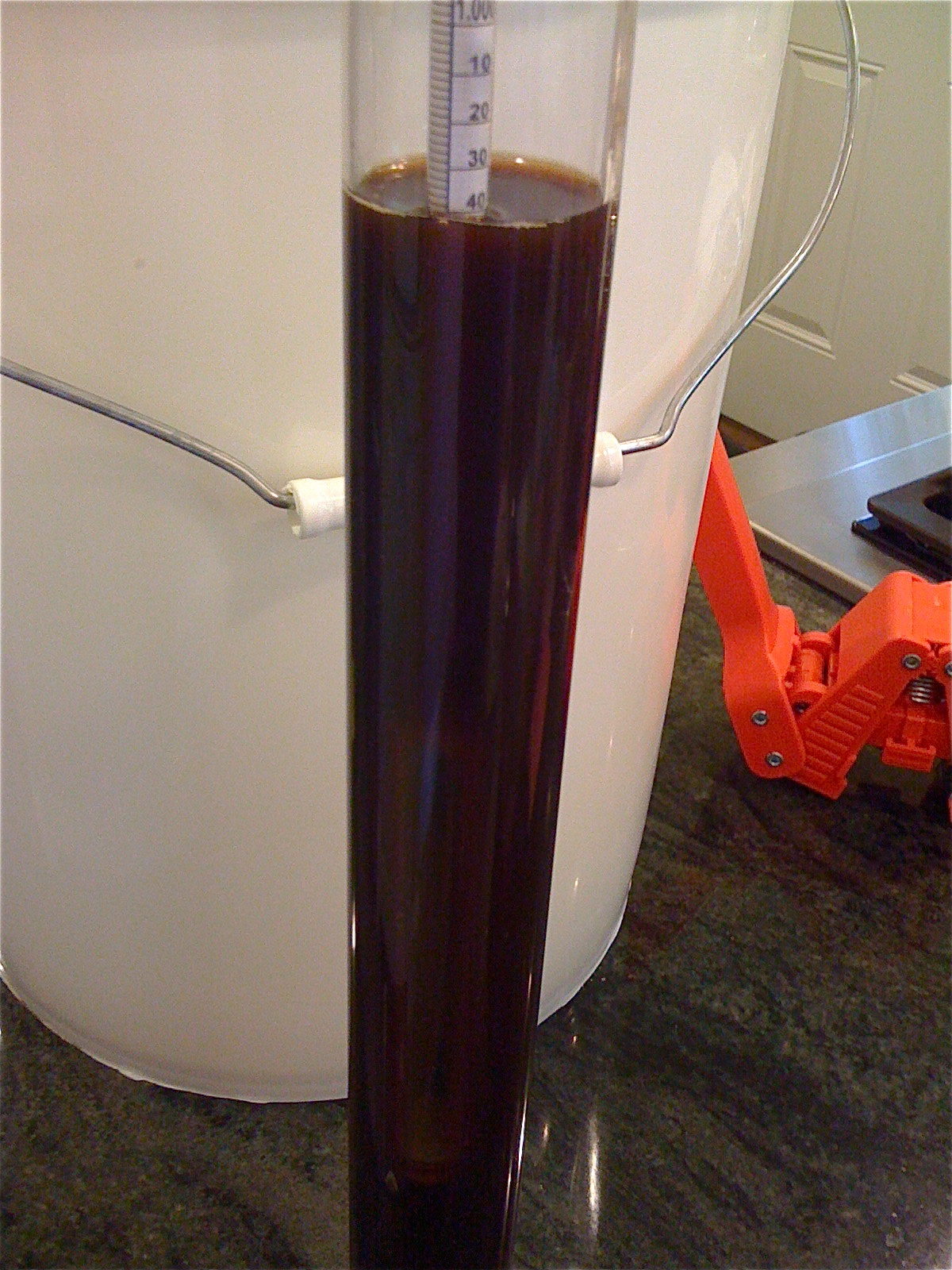
After two weeks in the fermentor, I decided the rye Scotch ale was close enough to what I was looking for to move ahead to the barrel phase of the JD Project. Although the beer was still very young, it didn't have the overwhelming rye bite that my earlier batches had. Pitching only half the amount of yeast also helped the beer retain some of the body, while still reaching a respectable 8.1 percent A.B.V. (F.G.: 1.030) The alcohol percentage will climb higher, of course, after the beer spends a couple weeks in the bourbon barrel and then a month conditioning in the bottles, but it shouldn't taste too boozy (well, except for the booze it's aging in).
I had wanted to get this project done last month so I could submit it into The Bruery's homebrew competition, but the extra time ended up working out for the best. I may have missed the competition (which I wasn't going to win), but I happened to get some good advice about barrel aging beer and maintaining the bourbon barrel at a brewing class I took yesterday.


One of the homebrew clubs in Maryland, C.R.A.B.S., holds an all-grain class at Maryland Homebrew every couple of months. I signed up to see how much work is actually involved in all-grain brewing verses extract, which is what I've been doing so far. Turns out, it's not too hard. At least it doesn't look too hard. You need some extra equipment and it takes a few more hours to brew a batch of beer, but it all looked very manageable. With any luck, I'll be all-grain brewing by the end of the year. Not only will I have more control over the brewing process and my ingredients, but my cost per batch should also drop by $20-$25.
The guy who ran the class had some experience with barrel-aging beer and told me what I needed to do to keep my barrel in good shape between batches of beer. He also advised me to make sure the barrel was still wet with bourbon when I added the beer. People, that's good advice.


What may be the best added benefit of this project is all the aged Early Times I now have. However, it's not as much as I started with. The 10 liter barrel held six large (1.75 liter) bottles of Kentucky bourbon. After seven months and two weeks, the barrel gave back roughly four and a half of those bottles. I knew I'd loose some volume to evaporation (the angel's share) and absorption into the wood (and the occasional quality-control check), but nearly three liters is a lot of loss. Ah well, I guess I'll have to make due with the eight liters I have left.
So who needs a Manhattan?

Monday, January 31, 2011

JDP4: No contest, fourth time is a charm (right?)


You win some, you lose some, and sometimes you bow out of the game.
JDP3 didn't pan out how I wanted, so I didn't bother entering it into The Bruery's homebrew competition. Not that I would've won. I hear that they were getting entries from around the world (including doc from the BN), so whatever homebrew wins, it will surely be an excellent beer. The JD Project may produce an excellent beer one day, but not yet, and certainly not JDP3.
Like JDP2, there's just too much rye. Although there is plenty of malt, that rye bite is too prominent. The missus described it as medicinal. At times it was, though that seems to be fading with age. Still, it's not a scotch ale, so on to JDP4.


For this batch, I've stepped up the crystal malt and dialed back on the rye. This should be a big, malty ale, with a slight bite of rye. Of course, the last beer should've been big and malty with a slight rye bite, but what are you going to do? Considering that the original gravity was 1.090 at 74 degrees, it's certainly starting off on the right path.
In lieu of cooling the wort in the laundry tub, as I typically do, the missus suggested setting it out in the snow. Everything about this idea seemed bad. The world is full of bacteria and most of it lives outdoors. But the fermentation bucket was closed and I had an airlock and alcohol seal on it. So as much as the idea worried me, I couldn't think of why I shouldn't do it. So I did. Here's hoping the beer survives.


I'm beginning to feel the pressure to finish this project. The Early Times has been in the barrel seven months, so I don't want to push it too far and damage the whiskey (which tastes fantastic). I think for this batch, I'll let it hang out in the fermentor for about a month. If it tastes right at the end of the month, I'll go ahead and transfer it into the barrel and then into bottles for conditioning. I was hoping to produce and approve a test batch of the scotch ale before going ahead with the barrel aging, but I need to get that bourbon out of the barrel.
These are weird problems to have. I know. But they're the problems facing me.

Sunday, December 5, 2010

JDP3: So far, so good


I think this might just be the batch.
I bottled JDP3 this afternoon and judging by the final gravity (1.020), A.B.V. (10%), and taste, this might just be the recipe that I'll remake and stick in the bourbon barrel. The color is good, if a little lighter than I expected, and the wort tasted malty with the bite of rye clearly coming through. And there's just enough flavor from the smoked malt to let you know it's there. Once this gets a few days in the barrel, I think it'll be phenomenal.


However, now I'm working against the clock. I'll get a chance to taste the nearly finished beer on Dec. 21, the day before I fly to Florida for Christmas and New Years. I get back on Jan. 6. Realistically, I can get the next batch going on Jan. 7, and get it in the barrel by Jan. 12. The beer will then be in the barrel up to a week, which means it'll have about two weeks to bottle condition it before I ship a couple samples off to The Bruery. That's a tight time frame. Hopefully, Jan. 31 is the deadline to submit the beer, but the judges won't sample them for another week or so.
Even if I don't win -- and odds are that I won't -- I'll be happy to wrap up this project. I was hoping to have the American scotch ale recipe worked out by the time the barrel was ready and it looks like I meet that deadline. Because these batches are small, I'll probably do a second one before I stick something else in the barrel (stout?).
And a final hop update for the year: no hops. From the beginning, this year was a write off. I've heard and read that you should never expect much yield the first year you plant the hops. Well, sure enough, I didn't get a single damn hop cone this year. Not one. So, I'll take down the vines and look forward to a more robust season next spring (of course, one hop cone would constitute a more robust season). Fittingly, as my first year of hop farming comes to a close, I'm just about to finish off Digression³, my first wet hop IPA. The hop growth may have sucked, but at least the wet hop beer didn't.

Sunday, November 28, 2010

JDP3: The Goldilocks batch?

Grinding rye by hand is as much fun as you think it is.
My third batch of the JD Project is under way and the numbers look good so far.
The original gravity came in at 1.094, which is quite high, but no where near as high as the 1.135 the first batch started with. If the attenuation is good, I should end up with an A.B.V. of around 8 or 9 percent, perfect for a scotch ale.
For this batch, I returned the brown sugar and increased the amount of smoked malt. In the last batch, the smoked malt flavor never came through and the lack of brown sugar likely contributed to the lower A.B.V.  (That said, JDP2 was a good beer, it just wasn't a scotch ale. Once I got past that, I realized it was a really good rye ale. With the lower amount of malt and no brown sugar, the rye was the predominant flavor. That wasn't what I was going for, so it took me a while to appreciate the beer I did have. Now that I'm down to a few bottles, I'm actually a little bummed. I really like it.)


I also picked up a couple hop bags for this batch. Talk about making a difference. Transferring the wort from the pot to the fermentation bucket took no time at all because I didn't have to keep cleaning hop goop off the filter. Those little nylon hop bags should mean I'll have little to no trub in the beer. Man, that'll be a nice change.
Should this batch work out the way I hope, I plan to submit it to The Bruery's Batch 300 homebrew contest. The winner gets to make a commercial batch of their beer on The Bruery's system and enter the Great American Beer Festival's Pro-Am competition.  Now, I'm sure I have no chance to win, but what the hell, it never hurts to try.
Even if I don't win, even if the beer sucks, I have 10 liters of very good whiskey. Tell you what, though, that beer won't suck. Not once it's had time in my barrel of aged Early Times. I sampled some a couple weeks ago along side some regular Early Times. The difference was dramatic. The whiskey from the barrel was a rich caramel brown and was full of vanilla and brown sugar flavors. I like Early Times, but the stuff straight from the bottle paled in comparison to the 10 liters I'd aged for five months. It was nearly two different spirits entirely. If I can get the flavor of that whiskey to come through in the American scotch ale, I might just have a decent beer.

Saturday, November 6, 2010

FW1/JDP2: Cafe Con Leche and the Scottish Scotch Ale

It took 10 minutes to pour this beer.
So all that hand wringing I was doing over the sour flavors in the stout proved unnecessary. FW1 tastes good. By no means is it a perfect espresso milk stout, but it is more than drinkable.
The biggest problem with the beer is it's over-carbonated. I did add a bit more dry malt for bottle conditioning than I normally do, but I did so because think many of my beers have been a bit under-carbonated. Well with the stout, it takes five minutes to pour and I've already lost one to gushing and another to detonation (the bottle cap didn't pop off, the upper half of the bottle did). That said, once it's in the glass and settles, it's tart and a bit bitter from the espresso, and the creaminess of the body comes through ... once the carbonation subsides.
Since it's a espresso milk stout, I've named it Cafe Con Leche. Because I got the wort from Mike Roy at Franklin's, this batch is a one and done, but it has motivated me to tackle another stout in the next few months. I'll probably wait until I wrap up my scotch ale experiments.

JDP2 on the left and JDP1 on the right.
Speaking of JDP2, well, it's OK. It is drinkable, but the 6.4 A.B.V. and light body make it more of a Scottish ale than the intended scotch ale. And because I dialed the malt back too far and cut the brown sugar all together, the rye is too pronounced. So back to the drawing board. I think I should have the recipe pretty well dialed in by the next batch.
That said, JDP2 benefited as much from the addition of bourbon as JDP1. As you can see in the picture, JDP1 (on the right) is much darker than JDP2. It's also flat, while JDP2 has a nice amount of carbonation. JDP1 is overly sweet and overly boozy, while JDP2 is a bit thin and the rye gives it too much of a bite. Yet ... YET ... the bourbon cuts through both giving the beers a nice balance without overwhelming either. Isn't bourbon great?

I rise the tasting glasses in a small amount of bourbon to simulate what the beer will taste like after aging in the bourbon barrel.

Sunday, October 24, 2010

SR5: Delicious Digression³


"It tastes so fresh."
That was the best thing my wife could have possibly said to me. It tastes fresh.
It does, by the way. It really does. It's a wet hop ale. It's a single hop, wet hop ale. It's a dry hopped, single hopped, wet hop ale. It's Centennial hops from beginning to end and it is good.
I wanted to give SR5 another week to bottle condition, but I think it's ready. Tuesday is the next DC Homebrewers meeting, so I cracked open a couple to see if the beer is ready to drink. Man, is it. I really couldn't be happier with how it came out. It has a good bitterness that's well balanced by the crystal malt (20). The grassy flavor of the fresh Centennial hops comes right through, and the five ounces of dried Centennial hops make the beer stinky good.
I was worried that the wet hop flavor would be muted because of the number of days it took to get the hops from the field to me. But I hand it to Rebel Brewer, they were still fresh (it would've been nice if they remembered my SuperMoss so the beer would be more clear). It didn't help that Derek from myLHBS crapped on the idea of mail order fresh hops after I'd placed my order, but I guess he can suck it.
Nevertheless, this should be the last time I order wet hops from Rebel Brewer. With any luck, my own hops will be producing next year. If so, I can either look forward to a wet hop IPA with a combination of the Centennial, Willamette and Cascade hops I planted, or enough hops from each vine to do three single hops batches. Whatever the case, if the beers turn out as well as Digression³ did, then I'll be happy.
Digression³, by the way, is the name of the beer. Dry hopping a wet hop beer seemed like a digression from the concept (dry, wet, get it?). It's also a digression from the line of IPAs I've been working on. And I tend to digress a lot in my writing and conversations. The cubed refers to the three ways Centennial hops were used: bittering, flavor and aroma.
On a minor note, I got the carbonation right. The last couple batches, JDP1 and SR4, the beers were either under carbonated or not carbonated at all. I'd come up with all sorts of reasons why -- too much alcohol, not enough yeast, etc. -- but I started getting worried that I was screwing up something more fundamental, which would be harder to fix. So when I heard the wonderful tsst sound when I popped the cap on Digression³, I was pretty damn happy.
I also like the color. As you can see from the photo, it finished with a soft orange, brown color. That's more or less what I've been going for with the other SR beers. The difference between this beer and the other beers, in terms of malt, is the use of pale malt verses amber malt. Digression³ has no amber malt, while the other SR beers are almost all amber. I like the flavor of the amber malt, so I'll stick with it, but I'll swap out some for pale malt when I get around to making SR6.
For now, I have plenty of beer to drink.

Sunday, October 17, 2010

JDP2/FW1: I have a lot of beer


That's my fermentation room/basement beer closet. At present, it features five cases of beer: two cases of SR5, two cases of FW1 and one case of JDP2. It's fair to say that I'll be good for beer when all this homebrew is ready to drink come November.
On Friday, I bottled the FW1 cafe con leche stout and the JDP2 American scotch ale (which turned out to be more of a scottish ale due to the 6.4% A.B.V.). Now they'll need a few weeks in the bottle before they're ready. I'm hoping for a lot from the bottle conditioning.

I took this photo with my iPhone because my digital camera was on the fritz. Later, I went online to see if I could fix it. Most of the advice was to slap the lens. Sure enough, one good whack later and the camera was back in business.
The stout still had a sour taste, but I asked around about it and that might not mean anything. Evidently, many stouts, including Guinness, have a sour flavor (in fact, I picked up a four-pack of Guinness' new Foreign Extra Stout and sure enough there was a sour component). Still, I want the flavor tamed a bit. The additional dry malt I added for bottle fermentation and a few more weeks of aging may help.
The other issue I had with the stout was poor attenuation. After nearly two weeks of fermentation, the stout went from an original gravity of 1.072 to a final gravity of 1.042. That's only 40% apparent attenuation. I was expecting around 70%. I don't mind that the A.B.V. is 4%, but I am disappointed in how poorly the yeast performed. I do wonder whether I should have let the stout ferment even longer, and what effect the lactose had, but all that is moot now that the beer is in the bottle.
On the bright side, I did get a distinct coffee/espresso flavor from the beer. So I'm hopeful that the beer will be drinkable next month.


In terms of flavor, JDP2 came out better. It's certainly not nearly as malty as JDP1, but I think I went to far the other direction. The beer was almost too dry, and I missed the brown sugar. In fact, you can see from the light color of the beer that it's not quite right. A scotch ale should be a dark amber. This is much more of a Scottish ale in color and alcohol content.
The reduced malt did allow the flavor of the rye to come through, so that's working well, but I'm didn't get much of the smoked malt. That may change after the beer finishes bottle conditioning. For the next batch, I think I add the brown sugar back in and maybe another pound or so of pale malt. I'm getting close, but I'm not quite there.